

Email Marketing
Published:
Email Marketing
Qasim Farooq
Share

You’ve been there—staring at a crowded inbox, deciding what’s worth your time and what’s not. Most emails? They don’t stand a chance. But every now and then, one catches your eye, and before you know it, you’re hooked.
What’s the secret? A killer opening line.
I’ve learned this the hard way. When I first started sending cold emails, I thought the content was all that mattered.
But time and time again, my emails went unopened, ignored, or worse—deleted. That’s when it hit me: if the opening line doesn’t grab attention, the rest of the email might as well not exist. It’s the first impression, the make-or-break moment.
And it’s more important than most of us realize.
Here’s the reality: Backlinko analyzed 12 million emails and found that only 8.5% of outreach emails receive a response. That’s a staggering number of missed opportunities, often because the email doesn’t stand out right from the start.
It’s frustrating, but it’s also an opportunity—because when you get that first line right, everything changes. Suddenly, your email isn’t just another message in a crowded inbox; it’s the one they can’t ignore.
In this post, I’m going to share what I’ve discovered about crafting opening lines that actually work. I’ll show you examples, strategies, and the small tweaks that can make a huge difference.
If you’ve ever struggled to get your cold emails noticed, trust me—you’re in the right place.
Let’s figure this out together.
The Big Problem With Cold Email Introductions Today
When I first started sending cold emails, I thought the introduction didn’t matter much. I figured people would read the email if they were interested in the offer. I couldn’t have been more wrong.
Time and time again, I realized that my emails were being ignored—not because the content was bad, but because the first line didn’t grab attention.
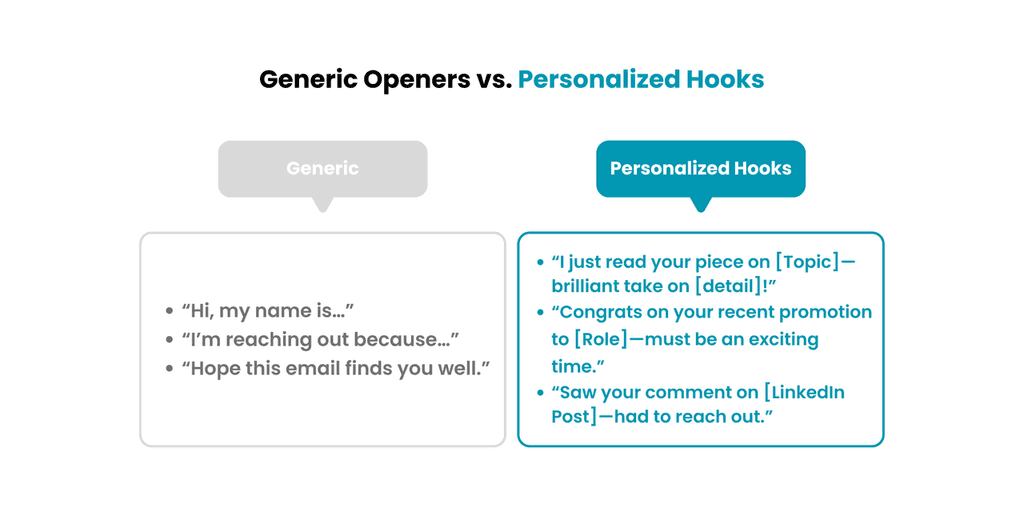
The biggest mistake I made, and that I see so many others make, is starting with something generic or self-focused. Phrases like, “Hi, my name is…” or “I’m reaching out because…” don’t spark curiosity or make the recipient feel seen. These openings make your email feel like just another pitch in a crowded inbox, easy to ignore or delete.
That’s why I now spend as much time crafting the opening line as I do on the rest of the email.
To make this process more precise and impactful, I use AI tools to analyze the recipient’s public profiles, content, and professional background.
These tools help me uncover key details, such as their recent achievements, areas of focus, or even shared connections, allowing me to personalize my emails in ways that genuinely resonate.
For me, the goal is simple: make the person on the other end feel like I’ve written the email specifically for them.
It’s not about tricks or flashy words; it’s about showing that I’ve taken the time and with AI’s help, the right insights to understand who they are and why I’m reaching out.
9 Proven Ways to Start Your Cold Email and Get More Replies

Observation-Based Openers
One thing that’s worked wonders for me is starting with an observation. Instead of diving straight into what I want, I focus on something I’ve noticed about the person I’m emailing. Maybe it’s a recent project they worked on, a piece of content they shared, or even a milestone they achieved.
When I highlight something specific about them, it immediately changes the tone of the email.
What I’ve realized is that people appreciate when you’ve taken the time to learn about them. It shows respect and genuine interest. And honestly, it’s not hard to do. A quick look at someone’s LinkedIn profile, a recent interview, or their company website often gives me more than enough material to work with.
When I’ve used this approach, the responses feel more personal, and the conversations are more meaningful.
It shifts the dynamic from a cold pitch to a real connection. For me, it’s not just about standing out in their inbox—it’s about starting off on the right foot.
Examples Worth Trying
When I’m crafting these observation-based openers, I always aim to make them feel genuine and tailored. Over the years, I’ve found a few approaches that work particularly well:
“I saw that your team recently won the [X Award]—congratulations! It’s clear you’re setting the standard in [industry].”
“I just read your recent article on [topic], and your point about [specific detail] really resonated with me. It’s clear you’re ahead of the curve.”
“I saw in your recent interview that [specific challenge] has been a focus for your team. I might have a way to help you tackle that.”
“I read your recent feature in Wired about tackling {{specific inefficiencies}}, and I was impressed by your AI-powered approach. It’s the kind of innovative thinking that’s shaping the future of the industry.”
“[Mutual Contact] mentioned you’re working on [project]. They spoke highly of your work, and I’d love to learn more about your approach.”
LinkedIn-Inspired Opening Lines
When it comes to cold email introductions, LinkedIn can be a goldmine for finding inspiration. It’s packed with professional updates, achievements, and personal insights that you can reference to craft a tailored and relevant opening line.
Over time, I’ve realized that referencing LinkedIn activity in an email not only makes the message feel personal but also shows the recipient that you’re paying attention to their work and contributions.
Whether it’s congratulating them on a new role, commenting on a recent post they shared, or referencing a shared professional connection, these small touches can make a big difference.
For me, it’s about creating a connection before diving into the core of the email. LinkedIn makes this easier because it gives you a direct window into what matters to your recipient right now.
Examples Worth Trying
“I noticed on LinkedIn that you recently started as [new position] at [company]. Congratulations! I’d love to hear about your plans for [specific area relevant to their role].”
“I came across your recent post on [topic] and was impressed by your take on [specific detail]. It’s a perspective I hadn’t considered before.”
“I saw that we both share a connection with [mutual contact]. They’ve spoken highly of your work, and I’d love to learn more about how you approach [specific area].”
“Your recent comment on [LinkedIn thread] about [topic] caught my eye. It’s clear you’re deeply involved in shaping the conversation around [related topic].”
Leverage AI for Hyper-Personalized Emails
Writing personalized LinkedIn-inspired opening lines can make your emails stand out, but let’s face it—doing this manually for every recipient can be time-consuming and challenging to scale.
That’s where GoCustomer, an AI-powered email marketing platform, changes the game.
GoCustomer specializes in crafting hyper-personalized email outreach by aggregating and enriching data from multiple sources like LinkedIn, websites, and other platforms. It uses specialized agents, such as its LinkedIn Agent, to gather detailed insights about your recipient.
For instance, by simply providing the LinkedIn URL of a recipient, the platform captures relevant data to help you craft tailored messages that feel authentic and deeply personal.
But the real magic lies in how GoCustomer solves the scalability problem. Instead of spending hours manually researching and drafting unique emails for each recipient, GoCustomer automates the process without sacrificing quality.
Its AI ensures that every email is tailored to resonate with the recipient, while robust drip campaigns and domain warm-up features ensure your messages land in their inbox, not the spam folder.
For example, let’s say you want to reach out to someone who recently started a new role. GoCustomer’s LinkedIn Agent will capture this data, allowing you to write something like:
“Congratulations on your new position at [Company]! I noticed your recent post about [topic] and would love to hear how you’re planning to approach [specific challenge].”
This kind of hyper-personalized email shows the recipient you’ve done your homework, creating a positive first impression and increasing your chances of engagement.
By using GoCustomer, you can scale this level of personalization across hundreds or even thousands of emails, ensuring maximum reach and higher conversions—all while saving time and effort. If you’re looking to combine the power of AI with effective email outreach, GoCustomer is the tool to help you achieve that.
Funny Email Opening Lines
Sometimes, the best way to stand out in a crowded inbox is by making the recipient smile. I’ve found that lighthearted or humor-packed openers can work wonders, especially when used with the right audience.
The trick is to keep it appropriate and relevant—too much humor can backfire, but a little playfulness can make you memorable.
For me, using humor is about breaking the ice and making the email feel less like a formal pitch and more like a conversation.
It’s not about telling jokes; it’s about showing a bit of personality while staying professional. When done right, a lighthearted opener can lower the recipient’s guard and make them more open to engaging.
Also read: Crafting Hilarious Emails to Entertain Your Prospects: Email Funny Strategies
Examples Worth Trying
“I promise this email isn’t about extending your car’s warranty—it’s way more exciting than that, I swear.”
“I read your profile and had to reach out. Anyone who can [specific accomplishment] deserves an email as impressive as they are… I’ll try my best!”
“Is it too early in the day for an email about [specific topic]? I hope not, because I couldn’t wait to share this with you.”
“I’ll admit, this email isn’t as fun as a cat meme, but I think you’ll find it worth your time!”
Openers That Request Feedback or Input
One of the easiest ways to engage someone is by asking for their feedback or input. People love to share their opinions, and when you position your email as a genuine request for their expertise, it immediately creates a sense of value.
I’ve used this approach many times, especially when reaching out to someone with significant industry experience or thought leadership.
For me, this type of opener isn’t just about starting a conversation—it’s about making the recipient feel respected and valued for their perspective. It shows that you’re reaching out not just to pitch something, but because you genuinely believe they can offer insight or guidance.
Examples Worth Trying
“I’ve been exploring [specific topic] and came across your work. I’d love to get your take on [specific question or idea].”
“Your expertise in [industry/topic] caught my attention, and I’m curious: how would you approach [specific challenge]?”
“I’m working on [project/topic] and thought of you because of your background in [related area]. Would you mind sharing your perspective?”
“I recently read your insights on [topic] and found them fascinating. What’s your take on [related question]?”
Follow-Up Email Starters That Work
Following up can feel tricky—you don’t want to come across as pushy, but you also don’t want to let the opportunity slip away.
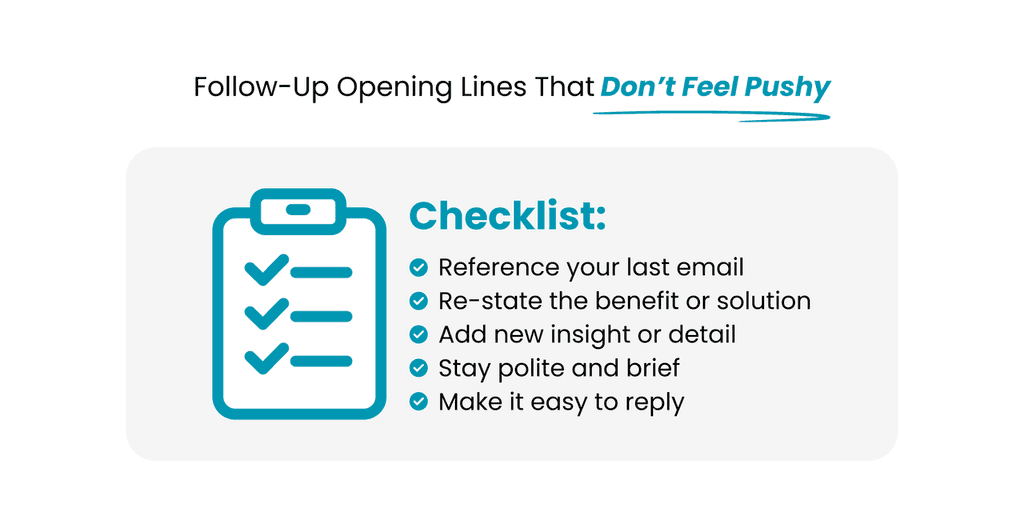
I’ve found that the key to great follow-up emails lies in crafting effective email opening lines that remind the recipient of your previous email or earlier exchange while giving them a reason to respond.
Your follow-up should feel more like a natural continuation of the conversation rather than just a reminder.
Whether you’re referencing a sales pitch, asking for a quick response, or revisiting a pain point, the opening sentence sets the tone for the entire email.
Examples Worth Trying
“I wanted to quickly follow up on my previous email to see if [specific topic] aligns with your current priorities.”
“Just circling back to our earlier exchange—have you had a chance to consider [specific point]?”
“Hope this email finds you well! I wanted to revisit [specific topic] and see how I might help with [specific challenge].”
“Following up on our recent conversation about [topic], I thought you might find this additional insight helpful.”
“I know you’re busy, so I wanted to send a quick follow-up to see if now is a better time to discuss [specific idea or offer].”
These follow-up email opening lines are particularly helpful for staying top-of-mind while showing professionalism and respect for the recipient’s time. A few points of personalization and relevance can significantly increase your chances of a positive response.
Achievement-Centric Opening Lines
Celebrating someone’s achievements is one of the best cold email opening lines you can use. By recognizing their recent success, you instantly grab their attention while demonstrating that your email isn’t just a mass send-out.
Over time, I’ve found this approach to be an effective way to stand out, especially in business email opening lines aimed at professionals.
Whether it’s a recent event, an award, or even a milestone the recipient’s company achieved, starting with an achievement creates a personal connection and shows genuine interest.
Examples Worth Trying
“Congratulations on your recent promotion to [specific position]! I can see why [company] chose you for the role.”
“I saw that your team recently launched [project or product]—what an impressive accomplishment!”
“Kudos to you and your company for being featured in [publication]! It’s clear you’re making waves in [industry].”
“Your recent award for [specific achievement] caught my attention—well deserved! I’d love to hear more about how you achieved it.”
“What an exciting time for your company! I noticed you recently reached [milestone]—congratulations on such a fantastic accomplishment.”
Using achievement-centric opening phrases not only grabs the recipient’s attention but also sets a friendly, professional tone, perfect for cold outreach.
Perfect Starters for Welcome Emails
Welcome emails are your chance to make a strong first impression, and starting with friendly email opening lines can make all the difference.
I’ve learned that the best opening sentences for welcome emails should acknowledge why the recipient signed up while making them feel valued. Whether they joined an email marketing campaign, downloaded a resource, or attended an event, your opening line should immediately create a personal connection.
For me, the goal is simple: create a warm, engaging opening that builds trust and aligns with your email marketing strategy.
Examples Worth Trying
“Welcome to [community/newsletter]! I’m thrilled to have you on board and can’t wait to share exclusive tips and resources with you.”
“Thank you for signing up for [specific resource]! Here’s what you can expect in the coming weeks.”
“I’m so glad you decided to join [specific program or group]. Let’s get started with your personalized guide to [specific topic].”
“Welcome to the [brand] family! You’ve taken the first step toward achieving your goals, and we’re here to support you every step of the way.”
“Thank you for joining us! I’d love to hear more about what you’re hoping to achieve with [specific area of focus].”
Winning Opening Lines for Networking Emails
Networking emails can feel daunting, especially when reaching out to someone you don’t know personally. The key to crafting winning opening lines for networking emails is to make them feel warm, genuine, and mutually beneficial.
Whether you’re referencing a mutual connection, a shared interest, or their professional expertise, the first line should set the stage for building a lasting professional connection.
I’ve found that networking email opening lines work best when they’re specific and personal. A generic opening sentence often feels forced, but mentioning a previous conversation or mutual interest instantly makes your email stand out.
The goal is to show that you’re not just reaching out randomly but that there’s a clear purpose behind your message.
Examples Worth Trying
“I noticed we’re both connected to [mutual connection] on LinkedIn, and I’ve heard great things about your work in [industry].”
“Your recent blog post on [topic] really resonated with me, especially your points about [specific detail].”
“We both attended [specific event], and I wanted to follow up with you regarding your insights on [topic].”
“Your expertise in [field or industry] has been an inspiration, and I’d love to hear more about your perspective on [specific challenge or opportunity].”
“I’m reaching out because I admire the work you’re doing at [recipient’s company], particularly your efforts in [specific area].”
These networking email opening lines are perfect for creating personal connections and engaging in meaningful conversations, helping you stand out in the recipient’s inbox.
Attention-Grabbing Openers for Sales Emails
Sales emails are notoriously challenging because they need to balance being persuasive with maintaining a professional tone.
The first line is critical—it determines whether your email will capture the recipient's attention or be dismissed. I’ve learned that attention-grabbing sales email opening lines focus on the recipient’s pain points, highlight value, or even introduce a touch of curiosity.
For me, starting with a compelling opening sentence that speaks directly to the recipient’s industry or business challenges makes all the difference.
By addressing their needs immediately, you show that your email is relevant and worth their time.
Examples Worth Trying
“Did you know [specific pain point] is costing companies like [recipient’s company] thousands of dollars every year? Here’s how we can help.”
“Many [recipient’s industry] companies I work with struggle with [specific challenge]. Does this sound familiar?”
“I’ve been researching [recipient’s company], and it looks like you’re poised for big things. I’d love to share how we can support your goals.”
“What if you could solve [specific pain point] and free up time for [specific benefit]? Let me show you how.”
Formal Email Opening Lines
When reaching out to professionals, government or city officials, or external stakeholders, using formal opening lines ensures your email is respectful and sets the right tone for a professional exchange. These professional email opening lines are not just about being polite—they help establish credibility and show that your message is intentional and worth their time.
I’ve learned that formal opening lines work best when they acknowledge the recipient’s role, tie the email to a specific topic, and maintain clarity. They don’t need to sound overly stiff or robotic but should strike a balance between professionalism and approachability.
Examples Worth Trying
“I hope this email finds you well. I’m reaching out regarding [specific topic or project] and would appreciate your insights.”
“My name is [Your Name], and I work with [Company]. I’d like to discuss [specific issue or opportunity] relevant to your work.”
“It’s a pleasure to connect with you. As a leader in [specific field], your perspective on [topic] would be incredibly valuable.”
“I recently came across your work in [specific area], and I believe it aligns closely with a project I’m currently exploring.”
“I’m reaching out to explore potential collaboration opportunities in [specific area]. I’d value your input as we look for ways to make a meaningful impact.”

What You’re Getting Wrong in Cold Email Opening Lines Without Realizing
Writing a cold email that stands out can feel like a guessing game. You spend time crafting what you think is the perfect subject line and opening line—something that will catch their eye and draw them in—but then… nothing.
No reply.
It’s frustrating, right? I’ve been there more times than I’d like to admit, and it took some trial and error to figure out why.
The truth is, it’s not always the obvious mistakes that hold your emails back. Sometimes, it’s the subtle missteps—those small, easy-to-overlook details—that can derail your email before the recipient even makes it past the subject line or the first sentence.
But once you spot these issues, you can tweak your approach and see the difference. Let me share the mistakes I’ve uncovered (and learned to fix) so you can craft cold emails that actually get responses.
Overloading the Opening Line with Information
Trying to combine your introduction, reason for reaching out, and value proposition in one sentence makes the opening line cluttered and overwhelming. Keep it simple and focused. Use the opening line as a hook to spark curiosity.
For example, replace, “I’m reaching out because my company specializes in [X], and I believe we can help your team improve [Y],” with, “Your recent work in [specific area] inspired me to reach out with an idea you might find interesting.”
Sounding Too Robotic or Scripted
Emails that lack a personal touch or use overly generic language feel robotic and off-putting. Conversational, human-sounding openers are far more engaging.
Instead of writing, “I am writing to introduce myself and my services,” use something more natural like, “I saw your recent feature in [publication], and it made me want to reach out with an idea I think you’ll like.”
Forgetting to Tie the Opener to the Email’s Goal
An opener that doesn’t connect to the email’s main purpose wastes an opportunity. Avoid vague compliments or unrelated observations.
Make sure your opening line sets the stage for your message. For example, if pitching a solution, start with, “I noticed your team recently expanded into [specific market]. How are you managing [specific challenge] during this transition?”
Failing to Use Social Proof Strategically
Social proof can be effective, but listing irrelevant credentials or partnerships weakens its impact. Instead, connect social proof directly to the recipient.
For example, replace, “We’ve worked with industry leaders like [X],” with, “We’ve helped companies like [similar company] achieve [specific result], and I believe we can do the same for your team.”
Misjudging the Recipient’s Priorities
Assuming the recipient’s priorities without proper research can make your email irrelevant. Align your opening line with their current goals or challenges.
For example, instead of assuming, “I noticed you’re focused on [X], so here’s a solution,” write, “I noticed in your recent interview that you’re focusing on [specific goal]. I have a few ideas that could help you get there faster.”
Conclusion
Mastering cold emails has been a journey of trial and error for me. I’ve learned that the best cold email opening lines are the ones that feel personal, genuine, and relevant. Whether it’s referencing a LinkedIn post, using humor, or acknowledging an achievement, crafting the best opening lines can set the stage for a meaningful connection.
However, scaling these efforts while maintaining a personal touch can be challenging. That’s where Platforms like GoCustomer have made a difference. By automating data collection and helping craft hyper-personalized messages, it ensures each email feels authentic and leads to a prompt response—even when sending emails at scale.
The right opening line can make all the difference. With the strategies I’ve shared here and the support of platforms like GoCustomer, you’re equipped to grab attention, create genuine connections, and turn cold emails into opportunities.

Reach more customers with your cold emails
Table of Contents
In a nutshell
An effective cold email opening line is one that resonates with the recipient by addressing their interests, achievements, or challenges. It should immediately capture attention by showing relevance and a genuine understanding of their needs.
Many cold emails fail because they’re generic, overly self-focused, or irrelevant to the recipient. Opening lines that lack personalization or don’t tie into the email’s main message often get ignored.
Tone determines how your email is perceived. A formal tone is ideal for professionals and external stakeholders, while a conversational tone works better for peers or informal connections. Striking the right tone ensures your message is engaging yet appropriate.
Humor can work wonders when it aligns with the recipient’s personality or industry. However, it must be subtle and relevant. For example, a light-hearted comment about a shared challenge can create rapport, but forced jokes can backfire.
Monitor metrics like open rates and response rates. If you notice low engagement, analyze whether your opening lines are relevant, personalized, and aligned with the recipient’s priorities. Testing different approaches can provide valuable insights.
Subscribe to our Newsletter!
Digital advice costs money but we send it to
your inbox for free.
Related Blogs


Time is Money, and We're About to Save You Both!
Book a quick demo of our email marketing tools and watch as we transform your leads into loyal customers.

![A loop illustration w-auto h-[70px]](/_next/image?url=%2F_next%2Fstatic%2Fmedia%2Fvector1.7738e6de.png&w=256&q=75 "GoCustomer Platform Image")

Get in touch
Subscribe to our weekly Newsletter and receive updates via email.